Research Sourcing · Price Check
Ignore the crossed-out price. Every seller writes their own. Here is the number that actually tells you something.
A strikethrough is a claim, not a comparison. The only honest yardstick is what other sellers charge for the same vial at the same size. One supplier went and checked, by hand, and published the result.
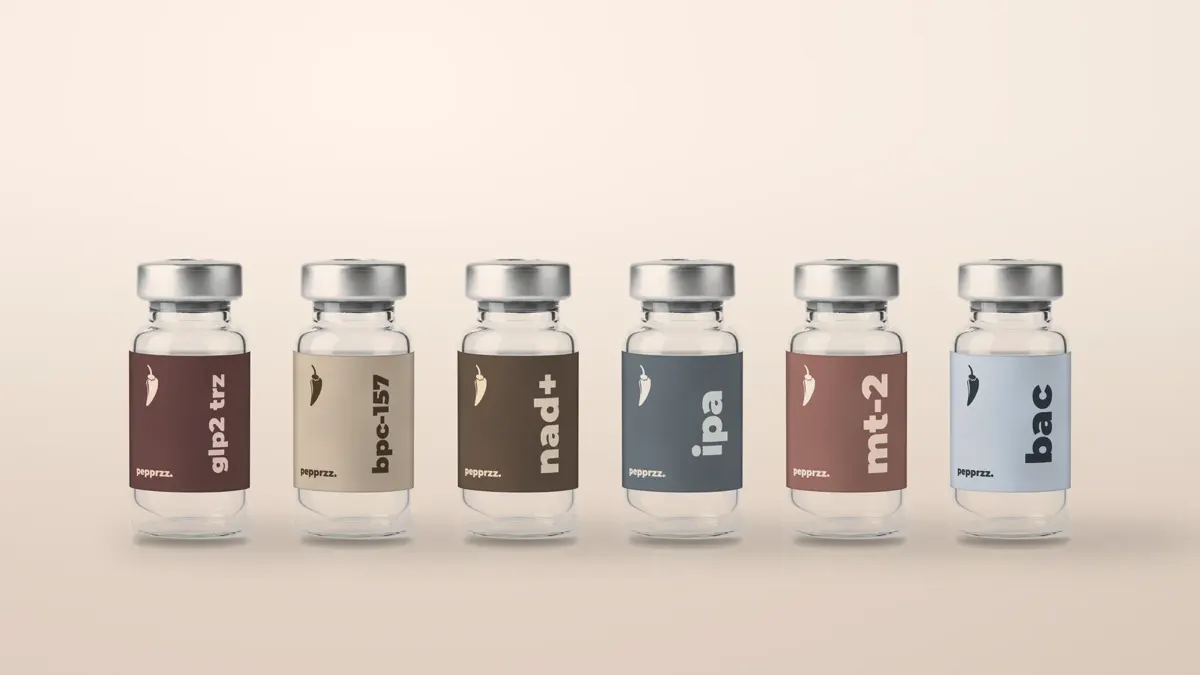 See the wholesale prices on Pepprzz →
Every research compound store in America has a crossed-out number on it. Was $120. Now $79. Save 34%.
Was according to who? The seller. It is their number. Nothing stops it being set high on purpose so the real price looks like a deal.
A discount off your own number is not a discount. It is a story.
Pepprzz shows the market price, not just its own.
Its price book sets the wholesale price next to the median at other US vendors. Every vial is 50% off list and nasal sprays are 30% off. No membership, no minimum, no code.
See the price book →1Why "compare at" is the weakest number on the page
It is not audited. It is not checked against anyone. It does not have to be a price anybody ever paid.
That includes list prices. Pepprzz prints a list price on every product too, and charges half of it. Fair enough. But the list alone would prove nothing, so they did something most sellers do not do.
2The yardstick that works: the market median
Take the same compound at the same size. Price it at every US research storefront you can find. Count the sale price if a sale is running, because that is what a buyer actually pays that day. Take the middle number.
That is the median. One cheap outlier cannot drag it down. One greedy outlier cannot push it up. Pepprzz did this by hand and published it as its price book.
Their words: nothing here is a made-up compare-at number.
Medians from the Pepprzz price book, taken across 7 to 10 US vendors per compound, checked Sep 25, 2026. Pepprzz prices as listed Oct 12, 2026. Prices elsewhere change; theirs are always live on the site.
Notice the gaps are not all 50%. Some are bigger, some smaller. That is what a real comparison looks like. A made-up one is suspiciously round every time.
 See the wholesale prices on Pepprzz →
3Then go one step further: per milligram
Two vials can be the same price and hold different amounts. Per milligram is the unit buyers actually compare across vendors, and Pepprzz prints it on the listing.
A 10 mg vial at $34.50 is $3.45 per milligram. Now you can line it up against anything.
4The checklist
- Skip the strikethrough. It is the seller's own number.
- Find the market median. Or a seller who publishes theirs, with a date on it.
- Divide by milligrams. Price per vial hides size games.
- Check the price applies to one vial. Not a kit, not a tier, not after a code.
- Make sure the testing survived the discount. Pepprzz publishes a batch-matched certificate from an ISO 17025 lab for every batch.
Check the price book yourself.
The wholesale price, the US median it beats, and the price per milligram, all on one page.
See the price book →
Comments
The point about the gaps not being round numbers is clever. Real data is messy.
Agreed. And the date on the medians is what made me trust it.
I had been comparing price per vial for months. Per mg changed my whole shortlist.
NAD+ at $29.50 against an $87 median is a big gap. Went and checked two other sites and it held up.
Good that they say prices elsewhere change. Honest way to put it.